Renter-Friendly Organization
Small Closet Organization Ideas for Renters
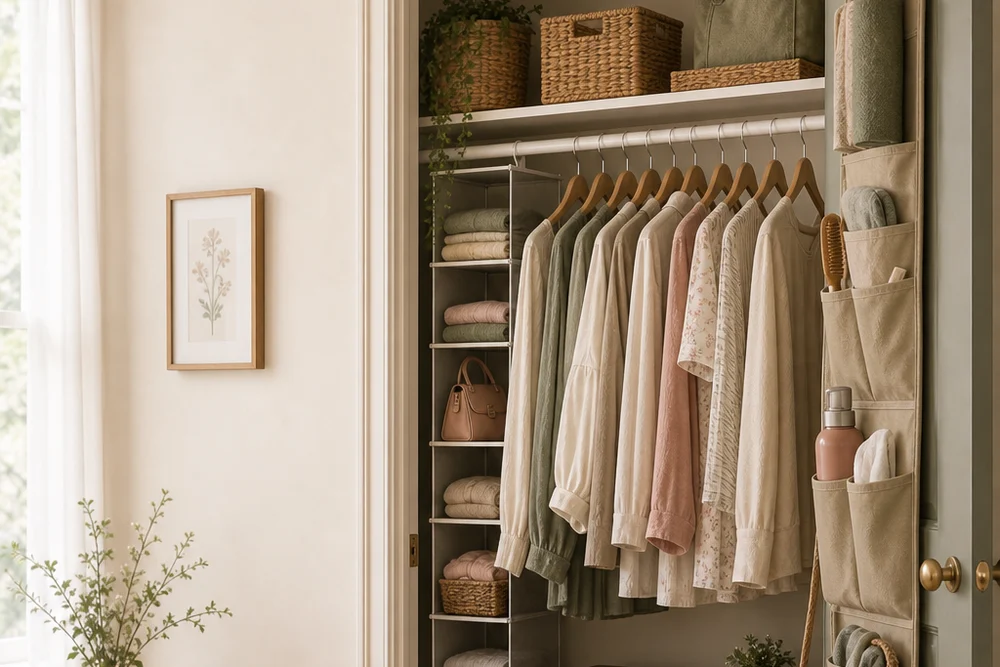
A small rental closet is easiest to improve when it is treated as four separate zones: rod, upper shelf, floor and door. The goal is not maximum theoretical capacity. It is to make current clothes visible, keep the daily path simple and use only additions that fit the closet’s depth, structure and lease constraints.
Affiliate pilot status: No commission-bearing links are active on this page. Candidate categories are included only as decision support; no retailer URL, product image or purchase call to action will appear without the required evidence and exact owner approval.
Begin with an edit, not an organizer. Remove empty hangers, laundry, returns and items that belong elsewhere. Group garments by length. Once long coats and dresses occupy one side, the open space below shirts and folded trousers becomes measurable.
Measure the closet as a working volume
Record the door opening, interior width, depth and height. Measure from the front edge to the hanging rod, from rod to shelf, and from the shortest garments to the floor. Note baseboards, trim, sliding-door overlap, hinges and any light fixture. Check whether hangers already brush the closed door; adding a deeper hanging shelf could make that conflict worse.
Inspect the existing rod and shelf without assuming their capacity. Look for loose brackets, deflection or previous damage and use the maintenance process in the lease when something needs attention. New storage should not hide or add load to a weak installation.
Selection guide: who each option is for—and not for
- Slim clothes hangers. Best for: a crowded section of lightweight garments where rod width is the verified bottleneck. Not for: heavy knits that should be folded or structured jackets that need wider shoulder support.
- Rod-hung closet shelves. Best for: renters willing to exchange a measured run of hanging width for light folded items. Not for: shallow closets where a loaded unit would press into the door or obscure long garments.
- Over-door accessory organizers. Best for: light, frequently used accessories when door thickness, top gap and swing clearance are confirmed. Not for: sliding, mirrored or strained doors, or dense loads that alter closing and latching.
1. Standardize only the crowded hanger section
Slim hangers can reduce wasted rod width, but replacing every hanger is not always necessary. Start with the tightly packed section and choose a shape that supports the garment. Heavy knits often store better folded, while wide-shouldered jackets may need more structure than a thin hanger provides.
Keep a small run of empty rod so clothes can slide. A closet that technically holds more but cannot be browsed is not more functional.
2. Group by garment length
Place long garments together and short garments together. This creates a continuous floor zone beneath the short group instead of scattering unusable pockets along the rod. It also reveals whether a second hanging level is realistic.
Use simple rod dividers or spacing rather than complex categories. Work, casual and layers are often enough. The system should be understandable during a rushed morning.
3. Add a second bar only under short garments
An over-the-rod hanging bar can create another level for shirts or folded trousers. Measure the drop from the original rod, the lower garment length and the clearance above floor storage. Confirm the combined load allowed by the existing rod and the new component.
This approach is not suitable beneath dresses or coats, and it can make the back wall harder to reach. Test a small section before extending it across the closet.
4. Trade rod width for hanging shelves deliberately
A fabric hanging unit turns part of the rod into folded storage. That trade is useful when sweaters, bags or denim take more volume than hanging clothes. Measure the unit at its loaded width and depth; soft sides can bulge into neighboring garments or the door.
Keep dense items low and do not overload fabric shelves. A rigid freestanding unit may be more stable when the closet floor is level and deep enough, but it consumes a larger footprint.
5. Give the upper shelf a front-facing plan
The top shelf works for light, infrequent categories that can be lifted safely. Use shallow labeled bins whose handles remain visible from the floor. Measure vertical hand clearance, not just container height, and avoid stacking where the upper bin must be balanced overhead.
Clear containers show contents but also packaging. Opaque bins calm the view but need accurate labels. The storage-bin fit guide compares material, lid and access trade-offs.
6. Keep the floor pullable
The floor should not become a wall of loose shoes and bags. Use one or two containers that can be pulled completely through the door opening. A low rolling cart can work where the threshold and depth allow it; a handled bin is simpler where casters would catch.
Leave access to the back corner and avoid placing heavy objects where they must be dragged across a rental floor. Felt or compatible protective pads may help, but check both the pad and flooring guidance.
7. Treat shoe storage as a current rotation
Keep current-season pairs in the closet and move active daily shoes to a measured entry zone. Store clean, dry shoes where air can circulate, and avoid crushing them in an oversized basket. The small-apartment entryway guide helps decide which pairs should remain at the door.
8. Check the closet door before using it
An over-door organizer can hold light accessories without occupying the floor, but it needs clearance above the door and behind it. Check door thickness, hinge movement, handle position and contact with adjacent walls. Load can change how a light door closes.
Sliding, folding and mirrored doors may not accept the same hardware. Do not force a generic hook over a door or frame that it does not fit.
9. Use wall-mounted options only after approval
Removable hooks can organize belts or a light bag on some surfaces. Their performance depends on paint, texture, preparation, moisture, temperature, load and removal. Check the lease and manufacturer process, patch-test where appropriate, and retain a freestanding fallback.
Never use an adhesive label as evidence that a method is suitable for a particular wall. If attachment or anchoring is required for safe use, obtain the necessary permission or reject the option.
10. Build a weekly reset
Keep one donation bag outside the closet, return empty hangers to a single point and move laundry to its proper container. Once a week, restore floor access and face labels forward. The reset should take less time than choosing an outfit; if it does not, categories are probably too detailed or storage is too full.
Understand the trade-offs
More hanging levels increase capacity while reducing visibility and long-garment space. Fabric shelves are light and portable but carry less weight. Rigid drawers offer smoother access but need exact depth and a level floor. Door storage preserves floor area while adding hardware and motion constraints. High shelf bins free prime space but make heavy or daily items less accessible.
Choose the smallest change that resolves the repeated bottleneck. Use a cardboard box as a temporary bin for a week, or tape the proposed footprint on the floor. That trial often proves whether the new zone will remain usable after the door closes.
How we researched and edited this guide
This guide uses editorial desk research and fit analysis and is not based on product trials. We compared category-level dimension, installation, load and removal criteria with common rental-closet constraints, then kept only checks a reader can verify in the actual space. We did not rank specific products or make price or performance claims. Any future candidate still requires exact manufacturer evidence, a real approved product URL, a rights-cleared local image and exact owner approval.
Continue the apartment plan
For a budget sequence, see 15 renter-conscious storage ideas. For a complete move-in order, use the first-apartment organization checklist, or return to the eight-guide collection.
Frequently asked questions
How can I add closet storage without drilling?
Start with the existing rod and shelf, then compare slim hangers, rod-hung shelves, a second hanging bar, floor bins and door storage. Each option still needs a fit and load check.
Can a tension rod support a full row of clothes?
Capacity depends on the rod, span, surfaces and installation. A bar that hangs from an existing closet rod is often easier to assess for short garments, but all manufacturer limits still apply.
What is the fastest small-closet improvement?
Remove empty hangers, group similar garment lengths and clear the floor. That exposes the real gaps before you spend on containers or extra hanging hardware.